


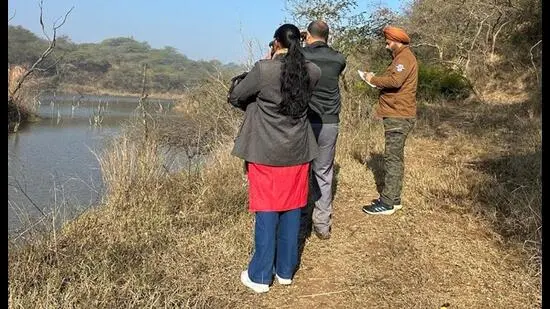
The three-day Waterbird (and allied woodland birds) Census of Sukhna lake and the 2,600-hectare Sukhna Wildlife Sanctuary (SWS) was completed on Friday by the Chandigarh forests & wildlife department with technical assistance from the Wildlife Institute of India (WII), Dehradun, and WWF-India (Harike team).The census was supported by bird identification experts, NGOs, government teachers and students.
The census data will be included in the final report of the WII, which conducted the rapid assessment of biodiversity of Chandigarh UT (wildlife survey) over eight days in November 2025. This writer was team leader for one of the four bird identification and count teams at the lake and the SWS (two teams), Wednesday-Friday.
Great cormorants, common pochards and ruddy shelducks outnumbered other migratory bird species in the census conducted at the lake. Due to the lake brimming with water, the numbers and diversity of migratory waterfowl reflected a decline in keeping with the trend since the winter of 2016-17. Lack of basking sites and food in deep waters at the lake have resulted in migratory waterfowl opting for other sites in the greater Chandigarh region, such as Mote Majra near Banur.
An extremely rare species for Chandigarh and the SWS, a maroon oriole was spotted on Friday by this writer at the Bade Attuwala Dam 2, falling within the Barotiwala block of the SWS. Other notable species enumerated at the SWS dams included the IUCN Near-Threatened ferruginous duck, Eurasian green-winged teal and Eurasian wigeon.
The lake is a designated wetland of national importance. “Our aim is to have the Sukhna lake recognised at the international level. The UT Administration has already submitted the proposal for the Sukhna lake’s inclusion in the Ramsar List of Wetlands of International Importance to the central government. The Union ministries of environment, forest & climate change and external affairs will further process the proposal for submission to the Ramsar Secretariat in Gland, Switzerland. The Waterbirds’ Census will augment our case for the lake’s inclusion in the Asian Waterbird Census (AWC),” Chief Wildlife Warden Saurabh Kumar told this writer.
Fragile, elegant and die-hard
If one can imagine an elegant and tall lady striding, impossibly, with poise and balance on the thinnest and highest of stiletto heels, then her natural counterpart would be the black-winged stilt. This seemingly fragile bird is seen commonly in wetlands as well as the dirtiest and most polluted of village and roadside ponds. It courses through shoreside waters on thin, long pinkish legs with consummate elegance.
Flocks of stilts currently occupy the heavily-silted ponds at the Sukhna lake’s regulator gates spillway and afford an easy view for bird watchers.
A stilt had the narrowest of escapes at the famous Mote Majra wetland near Banur in Punjab. A flock of 15 stilts was feeding in the wetland when there was a flutter and flurry amongst the congregation of waterfowl, resulting in an upheaval of water and spray. The answer came in the guise of a dark shadow sweeping low across the waters: a dreaded raptor, the booted eagle. This raptor is so named on account of its “completely feathered” or “stockinged” or “booted” long legs.
“I was photographing cormorants when all of a sudden the eagle picked up a stilt and spirited it away. The stilt was struggling hard to free itself from the eagle’s talons. Unlike a falcon’s methods, the eagle had not attempted to kill the prey in mid-air and subdue its struggles once and for all. The eagle alighted with the battling stilt on a wall, then a tree, and finally in a patch of grass in the wetland. It was here that the die-hard stilt made good its escape from the eagle’s clutches,” wildlife photographer Gagan Gyan told this writer.